VPP Policy Map
A structured map of the state VPP policy landscape.
Every rule a state needs to write to enable virtual power plants, organized into one framework, mapped as content, and built into a tool regulators can navigate.
Free to use for state commissions and energy offices.
The problem
States are writing the rules for virtual power plants. Nobody gave them a map.
Say a state wants the batteries and smart thermostats in people's homes to sell power into the regional market. That one goal touches a dozen policy topics, each with its own docket, stakeholders, and history. Most commissions are working through it with a handful of staff and no structured way to see what is done and what is missing.
FERC Order 2222 made this urgent. Every state in a participating regional market now has to write these rules. The research to do it exists, spread across dozens of organizations. What doesn't exist is a structured way to see which rules a state already has, which ones it still needs, and what other states have done.
The Framework
One way to organize every VPP rule a state might write.
The VPP Policy Framework sorts the rules into policy topics, groups the topics into four categories, and breaks each topic into a ladder of Policy Readiness Levels. A level is an observable regulatory condition: a rule that exists, a process that has been established, a standard that has been adopted.
Policy Readiness Levels were developed with VPP companies, grid operators, policy experts, and state regulatory staff, and each one is drawn from regulatory precedent.
Deployment / Buildout
Interconnection
PRL 1
BTM Storage Process
States set and require a BTM storage interconnection process (distinct from solar), non-exporting.
PRL 2
Export-Enabled InterconnectionMinimum for FERC 2222: PJM States
DER interconnection regulations allow batteries and EVs to export to the grid.
Further development
PRL 3
VPP-Aware Agreements
State and local regulators incorporate additional rules into interconnection agreements, such as flexible interconnection, communications protocols, dispatch override requirements, and reviewing static limit impacts for DERs.
PRL 4
Aggregate Review (Static)
Updating DER interconnection processes to include the review of aggregate impact of DERAs and VPPs using static conditions.
PRL 5
Aggregate Review (Dynamic)
Updated DER interconnection processes include the review of aggregate impact of DERAs using dynamic conditions.
Levels order the milestones within a topic. They are not comparable across topics, and a higher level is not inherently better; readiness is relative to what a Guide requires.
The Map
12 policy topics. 4 categories. 47 regulatory milestones.
The initial VPP Policy Map shows the content needed to implement wholesale market VPPs under FERC Order 2222: every topic, every level, and the regulatory precedent behind each one, drawn from proceedings and rules that states have already put on the record.
Setup & Registration
Deployment / Buildout
Operational
Markets / Transactions
Developed in collaboration with VPP companies, grid operators, policy experts, and regulatory staff across fifteen-plus states.
The Navigator
How you move through the Map.
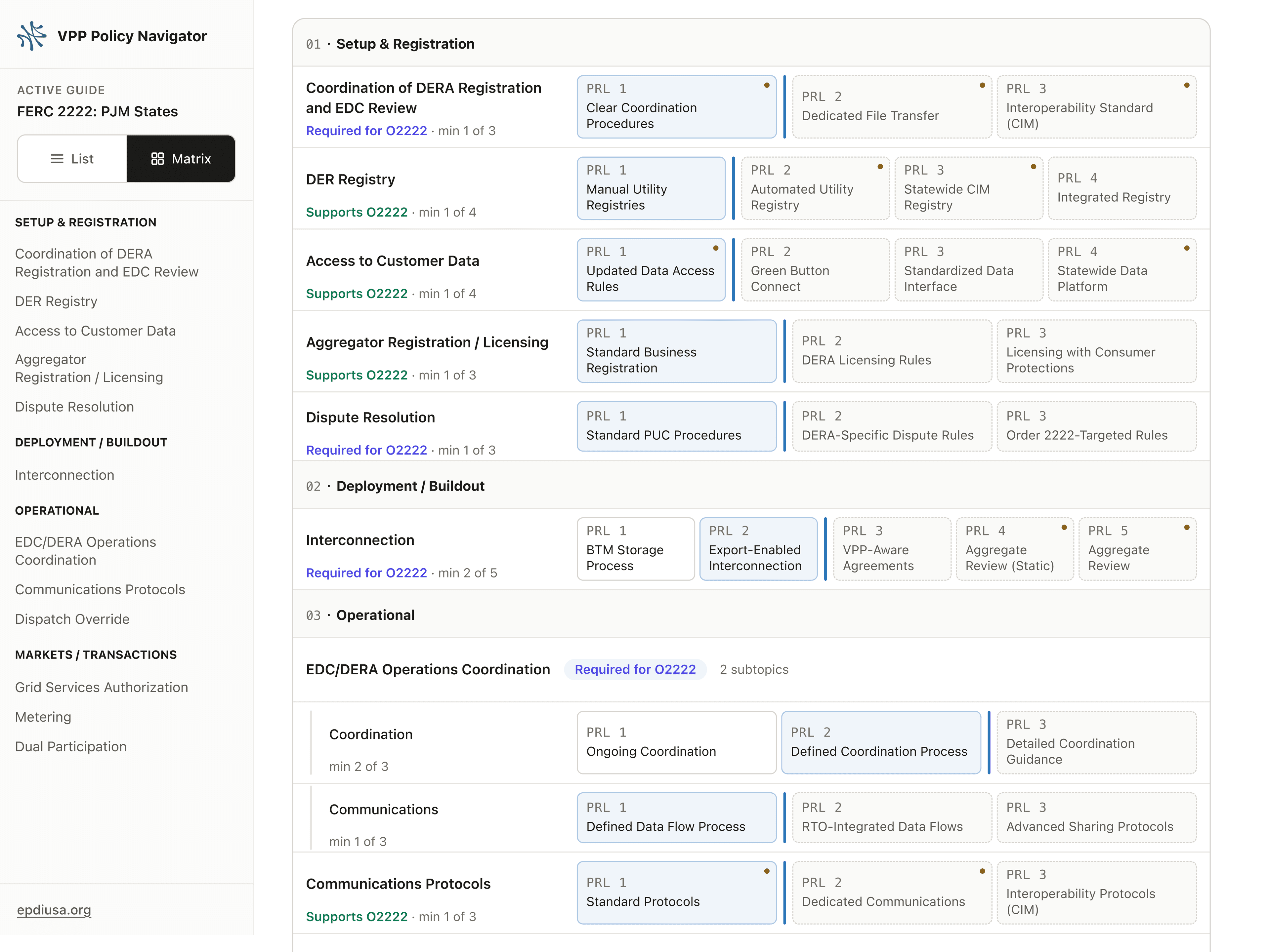
The VPP Policy Navigator is the tool. It starts from a scenario regulators recognize and shows exactly which decisions their state needs to make.
Step 1
Start from a Guide.
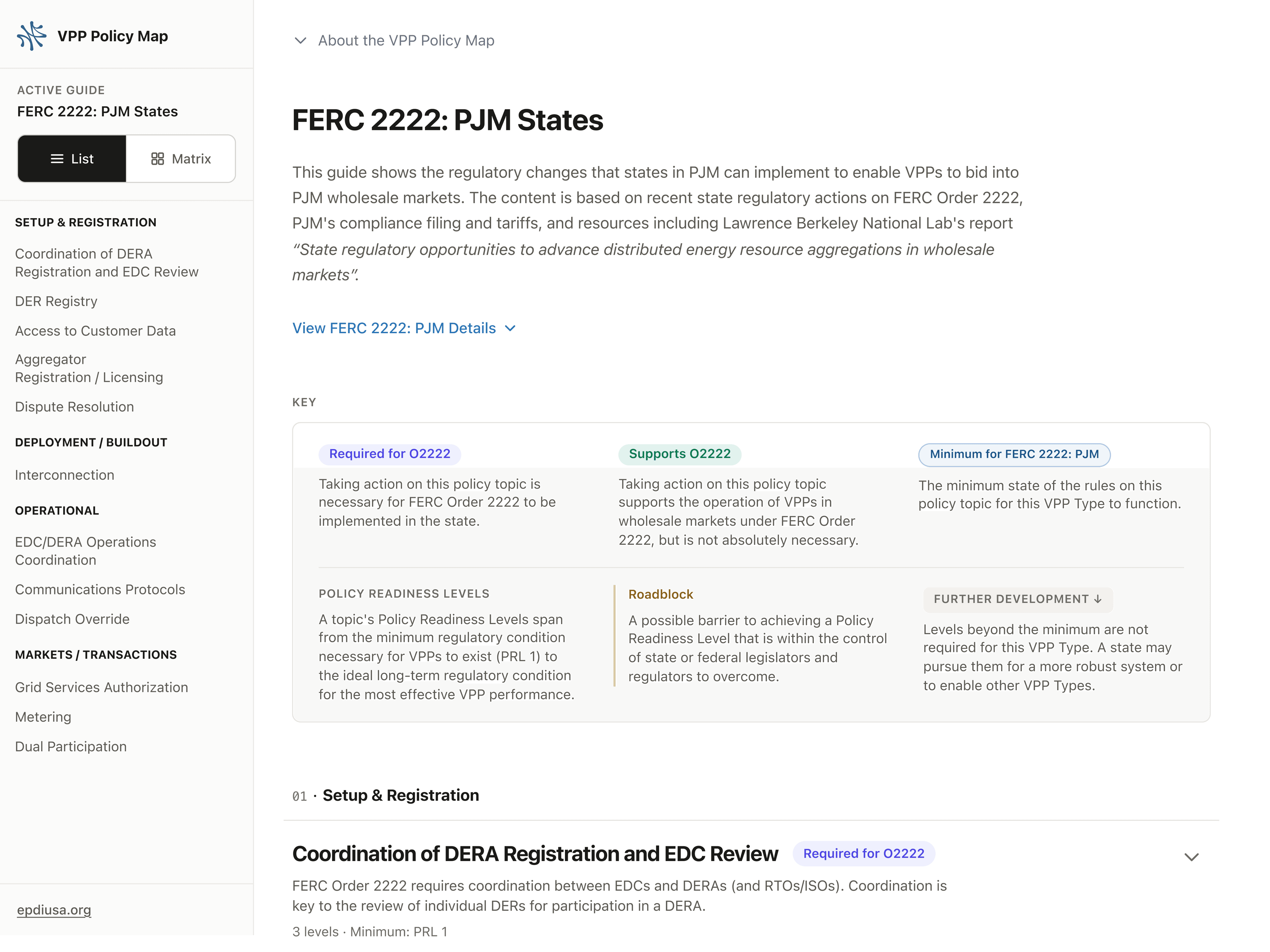
Each Readiness Guide covers one scenario. The first covers what a state in the PJM market needs so that aggregated resources can participate under FERC Order 2222. A key explains which topics are required, which support the scenario, and where the minimum sits.
Step 2
See the whole map at once.
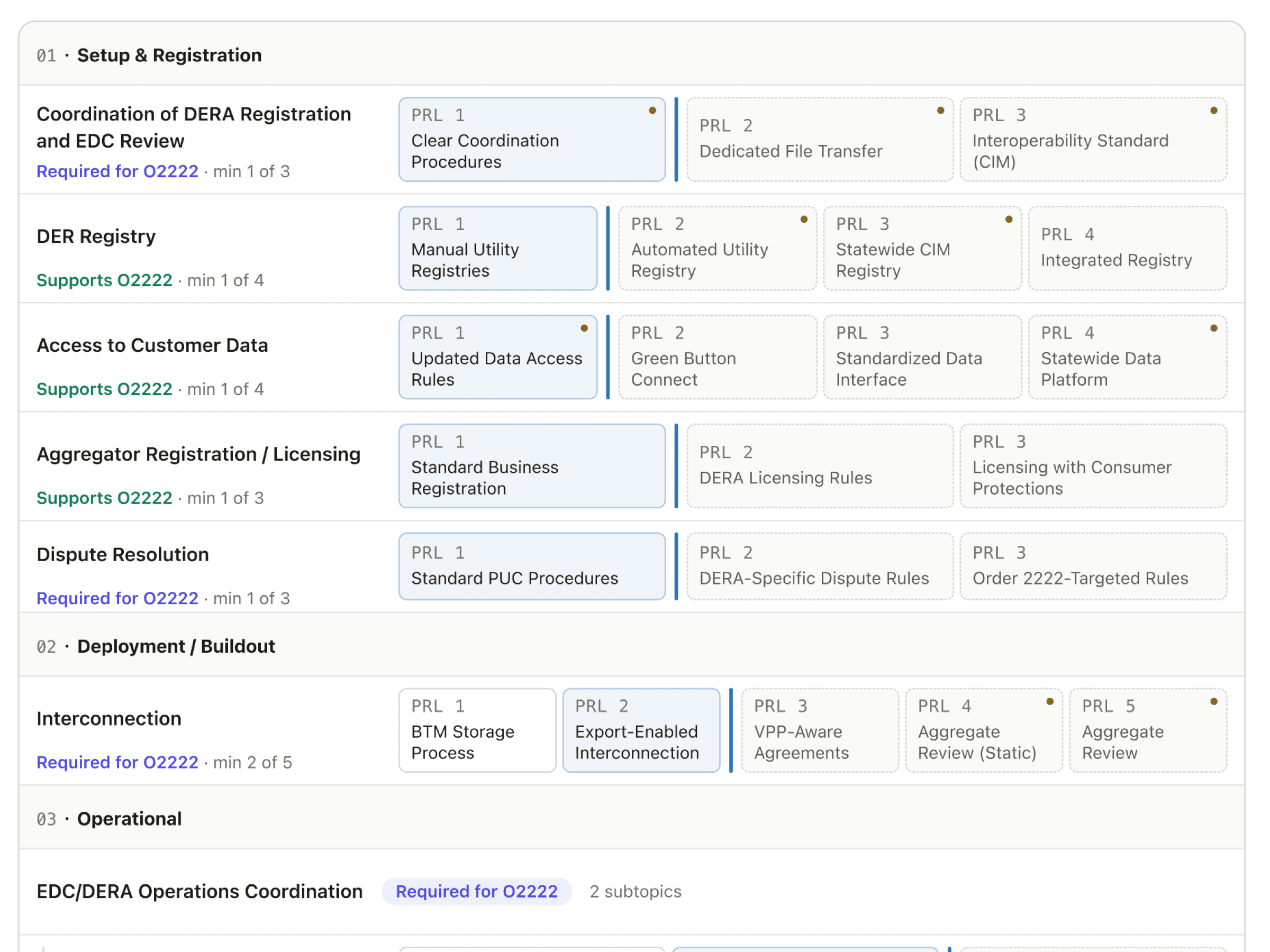
The matrix view lays out every topic and every Policy Readiness Level on one screen, with the minimum for the Guide marked. Regulators and their staff can see where the work is in one picture.
Step 3
Open a topic. Read the milestones.
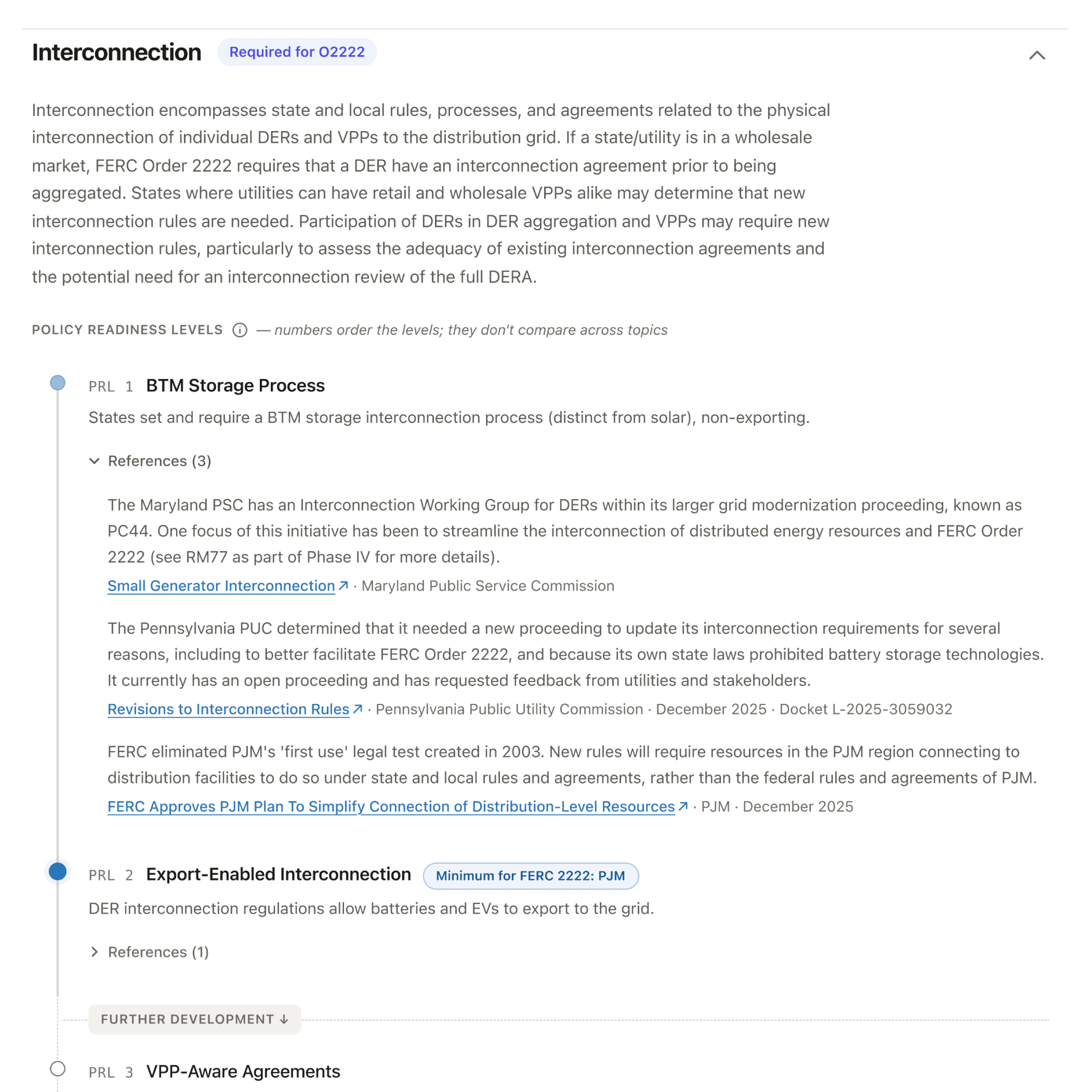
The list view expands each topic into its ladder: what each level means, the roadblocks along the way, and the sources it draws from.
What the Framework makes possible
You Are Here: Virginia
Because every level is an observable condition, a state can be assessed against the Map. This view is distilled from EPDI's work with Virginia's DER Task Force: it shows where the state stands on each policy topic.
State assessments are on the Navigator roadmap. Today they are delivered as reports; in the tool, a state will see its position on every ladder.
Why it's built this way
So the rules get written faster.
EPDI is a nonprofit. The Map and the Navigator exist so that states do not have to start from scratch, and so that the energy industry can converge on a consistent way to design and implement VPP policy.
Free to use
Available to any state commission or energy office at no cost. The work is funded so that states do not have to pay for it.
One vocabulary
When every state describes its progress in the same terms, regulators can see where they stand, funders can track what changes, and the industry can align on how VPP policy gets built.
Less duplicate research
Readiness levels are observable conditions, not survey answers. Progress is measurable, and the precedent behind each milestone is on the record for the next state to use.
The initial Map is available. Come walk through it with us.
See the Navigator with the people who built it, and where the work goes next.